Saturday, 1 February 2020

Origins of a Hiker - Part II: PCT origin story

This is Part II of my hiker origin story. Read Part I here.


11 September, 2016


Fresh off the back of finishing a Spartan Race, physically the hardest thing I'd ever done to that point in my life, I was feeling strong and ready for new challenges. The next week, we were in Seattle visiting my parents, and for old times sake I'd asked my dad to plan a day hike for us to do with him that would take in a good view of Mt. Rainier. He went through his library of hiking guidebooks and found just the thing: the Naches Peak Loop in Mt. Rainier National Park.

Dad delivered: stunning view of Mt. Rainier from the Naches Peak Loop. Dad's top tip is to go clockwise so you get a jaw-dropping reveal of the mountain when you turn a corner.

The three of us set off for this hike with lunch, snacks, water and sun screen, and enjoyed some beautiful weather and incredible views. I was snapping photos, and at one point I noticed that our trail had joined up with the Pacific Crest Trail. 

The Pacific Crest Trail, or PCT, is a 2,650 mile long distance hiking trail that winds through California, Oregon and Washington from Mexico to Canada. I'd known about it for most of my life, partly because a lot of Washington trails intersect with it, so I'd hiked on and around the PCT before. But mostly I knew of it because my dad's older brother had the aim of hiking the whole thing in sections over the course of his life. That had seemed like an enormous goal, but beyond that I didn't give it much thought. It was just something I'd always been aware of.
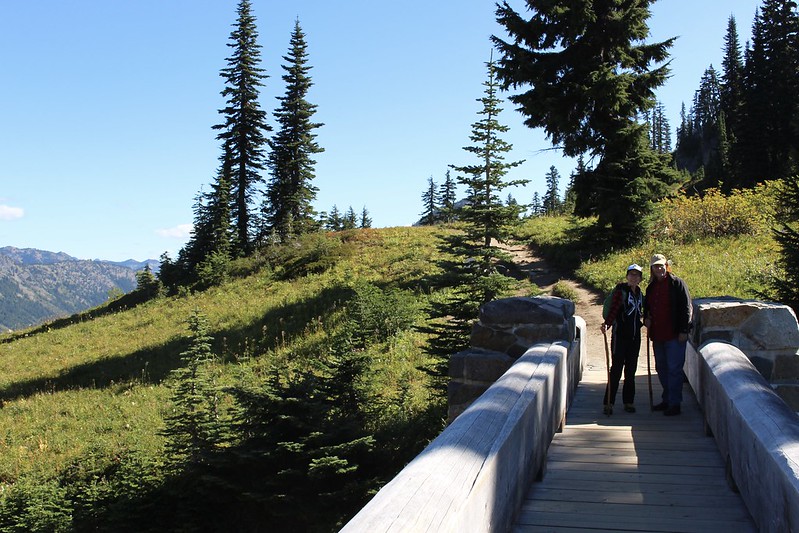

Dad and me posing on top of the Mt Rainier National Park entrance gate. Just over that rise I met my first thru hikers.

We had just stopped to pose for photos on a footbridge that spanned one of the roads into the park and then moved on when we came across a bit of trail traffic heading in the opposite direction. A young couple were at the front of a string of hikers, floating toward us despite the massive backpacks they were carrying. They looked like hippies: sun-toasted skin, oily hair, dirty clothes, and a serene glow.

"Hi there! How far are you going?" my dad asked. I wasn't surprised. He goes through life chatting to anyone and everyone, and while it sometimes embarrassed me when I was younger, I've come to admire it. When I'm on trail now I do the same.

"To Canada," they replied. It took me a moment to register. Wow, that's quite the section hike, I thought. That will take them weeks!

"Are you here because of The Book or The Film?" my dad asked knowingly. Later I was to find out that "The Book" and "The Film" referred to Wild, a non-fiction hiking memoir by Cheryl Strayed, which had popularised the Pacific Crest Trail. At the time, however, I had no idea what he was talking about.

The hippies muttered a slow reply - as if they were unused to speaking - that they had indeed read The Book, and my dad went on energetically. "Of course, she was really unprepared. Some of the things she did, it's so irresponsible..." The mostly one-sided conversation quickly faded and the quiet hippies drifted away. 

My dad: crushing miles and making friends.

"That makes sense," Dad mused as we hiked on. "This will be the time of year most of them are getting here,"

"Most of who?" I asked, still struggling to quite grasp what he and the hippies had been talking about.

"The thru hikers. You know, the people who have started at the Mexican border and are hiking the PCT all the way to Canada."

"They walked here from Mexico? All at once?!"

...is what I felt like saying. I tried to play it cooler than that, as if I had always known that you could walk the length of the United States in one go. But I was astounded. As we passed the rest of the queue of trail traffic, Dad stopped a few more grubby looking young people and chatted to them. 

They, too, had just walked. Here. From Mexico. They had chiseled, dirty legs and wide, easy smiles of the sort that seemed a universe away from all of my inner anxieties about how I ought to live my life.

For the rest of the day my mind was buzzing. They walked here. From Mexico. You can walk from Mexico to Canada in one go. One epic hike along the West Coast.

I wasn't fully aware of it yet but I had already decided that some day I would do it too. In Portland the next week, I bought a patch in Powell's Books that said "Pacific Crest Trail" and told myself in my quietest internal voice that one day I would earn that patch. 

This is the face of someone who has just decided to do something really hard and really exciting that will change their life.
I tested myself with thoughts like that for a few months as I started to read more about thru hiking and the PCT. I learned that the definition of a thru hike depends on the hiker, but that broadly it's a hike of every available mile of a long trail in a single hiking season or a single 12 month period. I learned that it can take 4 - 6 months to hike the PCT in its entirety, and your timeline is dictated by a weather window between when the snow melts in spring and when it falls again in Autumn on the highest elevations of the trail. And yes, I eventually read The Book and I watched The Film.

Finally, a few months after getting back to the UK, I started saying it out loud to other people in order to commit myself to it. I started saving money. I started a hiking log to keep track of the hikes we did and the lessons we learned on each. I planned overnight hikes for my partner and I to go on and finally got out the tent I'd bought years before. I started lists of gear, of skills to learn, of fears I had and how I would deal with them. I knew it would be years before I could do it because I would need to save money and somehow get the time off work, but I found myself planning and preparing with a focus that I'd never had before in my life. 

I decided that it couldn't wait until I retired to do it - I needed to get it done and not let "some day" become never. So I set myself the arbitrary goal of completing the trail before 2023, when I will turn 40, and told myself that no matter what it took - even if it meant quitting my job - I would attempt it. Well ahead of time I let my work know and got six months' unpaid leave for 2021, five years after I first decided to do it. Meanwhile, I continue to hike, to train, to save money and to prepare.

Over this time I've deciphered what that initial spark of inspiration was, and clarified what hiking the PCT means to me. It's a long love letter to the West Coast, the place I left but miss daily. It's a challenge that both frightens and excites me. It's outside the box - living in the woods as a dirtbag hiker for six months. It's a chance to find out what hiking means to me by doing nothing else. It's a place to practice grit and self-reliance. But most of all it was those hikers - grubby yet glowing - that inspired me. I want to know what resides behind those easy smiles and serene eyes.

That brings us to the present day, a little over a year before I will start my thru hike attempt. The plans are coming together and honestly, even if I have to leave the trail 100 miles in I will still be proud of myself. Committing to this goal, making a plan and carrying it out has made me a more determined, organised, self-confident person than I was before. I truly believe that the PCT has already made me a better person. I will endeavour to be worthy of the grand adventure that lays before me on a ribbon of dirt 24 inches wide and 2,650 miles long that will both test me and bring me home to myself. I want to meet the person that I will be at the other end.

I plan on posting my hike logs from the past as well as new hikes as they happen. I'll keep interspersing this with environmental and information management content, but I admit it's a lot easier for me to write about hiking than the other topics of this blog!

Origins of a Hiker - Part I

I thought it was high time I brought some hiking content in to this blog, because apart from the environment it's my other big passion and I started this blog thinking it could be my home for both. So you're getting backstory before we launch into trip reports, including several years of backlog!

My dad has been a hiker since he was a kid and his dad took him on hiking trips in the era of canvas rucksacks and heavy leather boots. He kept it up into adulthood, partly through hiking with his older brother and partly through annual trips with the local city council. As soon as my brother and I were old enough to carry our own rucksacks, we were joining him on the wilderness trails of Washington State each summer.

Dad's external frame pack and boots from his and Mom's trip hitchhiking around Europe and North Africa in the 1970s. Their grand adventure always left me feeling that I had a lot to live up to.


1989-1998


I find it hard to unpick specific hikes in my mind when I think back to my childhood. I remember campsites beside frigid alpine lakes, endless switchbacks up pine covered slopes, the deadened sound of footsteps on fallen needles through a mossy temperate rain forest and shuffling slowly along as Dad put more and more of my gear into his backpack. I remember getting a black eye from excitedly running down the trail toward our campsite, tripping and landing face first on a rock. I remember sitting down on a log, so tired I felt I couldn't go on, and my dad gently reminding me to drink some water and take it slowly, then getting up and walking twice as far as I had come by that point. I remember cautiously crossing my first snow field and asking my dad how to pee in the woods. I remember a night spent above the clouds in a fire tower that was so cold that I lay awake shivering in my sleeping bag and my brother needed to wear his spare socks on his hands. I remember the unlikely figure of a slight old man with a white beard, clad in black cotton clothing, with sandals on his feet and clutching a notebook in his hands. He looked overwhelmed to see a party of twelve in bright Gortex jackets charging up the trail toward him as he descended from his pilgrimage to the place where Jack Kerouac had spent a summer as a fire lookout.

Most of all I remember a sense of happiness. Dad would have us collect water and he would boil it on the heavy little stove before refilling our canteens. We would eat stodgy meals that had been sealed in metallic envelopes, sleep in our family's old green A-frame tent and wake up with the sunrise. By the time we returned home, every stitch of clothing would be damp with sweat or rain or dew, but we knew the earth a little better. That was what camping meant to me - a long hike away from anywhere, a deep silence, and a deep contentment.

When I got older, we stopped going for one reason or another. My last trip was in my first year of high school when we went with the city council. I went away to University and forgot all about hiking. Nature walks, sure, but camping was something you did with your family. Your dad planned the trip and you just packed your bag and followed along behind him. That was how it had always been. And so I went to sleep, and it took over ten years for me to wake up again.

2011


My first hike as an adult, up Pen y Fan in Wales. I was shocked and ashamed at how difficult I found it.

 "What are we going to do while we're there?" my partner asked when I suggested the trip to Wales.

"I've planned it all out. I found a place that does falconry experience days, and we're staying near this amazing little town that's full of bookshops so obviously we're going there. Also we're right next to the Brecon Beacons so we can go walking on one of the days."

I was planning a trip to Brecon, Wales for our wedding anniversary and I hadn't been hiking in a long time, but I thought that it wouldn't be too hard. I had a pretty physical job, after all, running around the biggest library in Cambridge fetching books for readers.

We decided to do a loop hike that took in two of the peaks, then looped back around and had a third climb before heading back to the bus stop. A third of the way up the first climb and I was practically hyperventilating I was so unfit. I flashed back to my younger self sitting by the side of the trail, complaining to my dad that I didn't think I could keep going. It was too hard. I wished I could just be done already. And this was just a day hike. I had barely any weight in my backpack. Ten years of studiously avoiding exercise and compulsively eating to dull my depression had done a number on me.

Later that year, my partner got an opportunity to go to New Zealand for work for two months, and I had the chance to go and visit briefly. While they were there, they went on some day hikes with co-workers and we went out together for a few walks. At the same time I was making the decision to turn my life around. I had been admiring roller derby players for a few years, thinking how cool they looked, then thinking, "But I could never do that." Then a childhood friend, who had never been active, took it up and quickly became amazing at it. Cracks began to appear in my self-perception. "If she can do that... maybe I can too?" I started working out. I joined roller derby. I started to watch what I was eating a bit more. Slowly, slowly, my life started to change...
Some things have been the same since that first day hike. We almost always take a bear with us.

2014-2016

Tackling a pretty challenging day hike in the Peak District just before the Spartan Race in 2016.
As I discovered I actually quite liked exercise and the outdoors, and gradually got fitter, we started taking a few more day hikes, usually as one small part of a holiday: Dartmoor, the Cotswolds, the Peak District and back to the Brecon Beacons for a longer loop than our first hike in 2011. My partner had still never camped before (apart from an ill-fated night at a music festival), so I thought it was high time we remedied that. I bought them a cheap two person tent for Christmas, but it waited unused for a long time. As 2016 rolled around I was working with a personal trainer and had set myself the goal of doing a Spartan Race (a 5k obstacle course race). I got into the best shape of my life, but the cost was a lot of wear-and-tear on my body and a not entirely healthy relationship with food. Still, I proudly trained for and completed the Spartan Race, raising over £800 for Alzheimers UK in the process. The week after that found my partner and me heading back to Washington to see my parents, and then on to Portland for a short holiday, with a few hikes I was looking forward to doing on the calendar.

Little did I know that one of those hikes would fundamentally change the course of my life.


To be continued in Part II

Wednesday, 22 January 2020

Book review - Feral: Rewilding the Land, Sea, and Human Life

As soon as I heard about rewilding as a concept, I was hooked. I seem to recall first hearing the word at the same time as finding out about the campaign to reintroduce the lynx to Britain, and while I'd heard for years about long-shot campaigns to bring back wolves, my affinity for felines meant my enthusiasm was easily sparked on this occasion and I started diving into it, looking for more examples.

I was surprised to find I already knew about perhaps the most stunning and well-known examples. When I was a kid, my family and I visited Yellowstone shortly after they reintroduced the wolf populations there and I remember feeling so excited to think that I might see one. Of course I didn't, but I think in my heart I always loved the idea of wild places even if I only ever got to see their margins. To me, just being in their habitat was exciting - quite the opposite of a zoo, where animals are in pens so small you can't miss them while you roam free. Instead, we stuck close to our cars and the well marked trails, and may not see anything more exotic than a grey squirrel, but it was more exciting knowing that the animals that were out there somewhere were living their lives the way they always had - the way they are supposed to. There was something right about wolves in the American west, just as there is something right about lynxes in Scotland. Giving predators the space to hunt means protecting huge swathes of land that can't help but become wild. Decades on, wolves have changed Yellowstone for the better, and in so many surprising ways. I can't help feel excited about what might happen to the landscapes of Britain if we let our native predators return and give them the space they need to thrive.

So, when I found Feral: Rewilding the Land, Sea, and Human Life by George Monbiot, a book about rewilding from a British perspective, I was very excited to give it a read.

It began a bit slowly for me. I found myself skimming over the personal anecdotes, but several did pull me in, and Monbiot is an undeniably talented nature writer. Instead, I chiefly hunted for the broader discussion of case studies, issues and theories around rewilding. I was not disappointed - the book was full of dispatches from the front lines of reforesting projects, species reintroductions and regulatory changes all in the interest of supporting biodiversity in the UK. Each of these examples impressed upon me how little is needed to turn the tide - one species, or two decades, or a few hundred acres can see the return of ecosystems that human activity had previously destroyed.

Just as ranchers near Yellowstone protested the reintroduction of wolves, however, rewilding in the UK is contentious for a variety of reasons. While I'm sympathetic to the fears and anger associated with governments telling working people what to do, taking their land for their own purposes, I believe that there is a compromise - an approach that works for both humans and non-human life. Halting environmental destruction is as beneficial to farmers as to politicians, and to present generations as to future ones.

I did take issue with two chapters that diverted into a somewhat different thesis, that humans long to be wild and thus create legends and folk heroes that represent "wildness" to our psyches. As an example of this longing he presented two figures: the fictional character of Johnny Byron from the play Jerusalem, who Monbiot reports is a drug dealer, a drunk, a fighter and a womaniser; and Raoul Moat, a very real person who murdered his ex-partner and her boyfriend and then evaded the police for almost a week before killing himself in a standoff. I find the casting of these two arguably misogynist figures as epitomes of a suppressed desire for wildness odd to say the least. While they represent a kind of unlawful wildness, I think that is a far cry from what rewilding represents. Wilderness and wildness are two very different things - a lynx kills to feed itself or its young, while Moat killed out of revenge, pride, or some other combination of urges. Nature obeys rules that keep a balance, quite different from drinking and copulating to excess. And to cast wilderness as exclusively - and even violently - male and masculine perpetuates the idea that the outdoors are no place for women and marginalised people. The idea of doing what one wants regardless of consequences is definitively unsustainable. Rewilding is not about roguish rule-breaking but about planting a metaphorical (or literal) seed and stepping back to watch what grows.

That diversion aside, I found this book an excellent and well-written introduction to the issues of rewilding in the context of the UK. Monbiot was very much preaching to the converted in my case, but I was glad to have more recent and geographically relevant examples than my childhood experience in Yellowstone. I find myself fascinated and excited by the concept of rewilding, and how it represents a radical shift from our present relationship to land use. That there is value in wilderness existing - not for humans to conquer, tame or extract from, but for its own sake - is a radical shift and one that is long overdue.

Friday, 25 October 2019

Workplace sustainability

If you're anything like me you've been watching people from Extinction Rebellion getting arrested with a weird tinge of jealousy. "I would do that, but I don't want to get sacked," you might be saying to yourself. Or, "If I really cared about the environment, I'd be out there gluing myself to the pavement too." But not everyone needs to serve the climate justice movement by getting arrested. In fact, it's a privilege that not everyone can have. But that doesn't make the rest of us less of an environmentalist. I've been donating to the fund that helps with legal fees for those arrested, but I think there's a lot more that each of us can do at our jobs than we might realise.

Whether it's the BBC magazine staff demanding that their employers boycott fossil fuel adds, or the Amazon employees walking out over a bold set of demands including a zero carbon target, workplace climate activism is having a moment in the spotlight. If something your employer does sits uncomfortably with your values, you can certainly make your voice heard.

I believe that one of the biggest impacts I can have is by keeping the conversation going and questioning the status quo at work. I've been an environment and energy coordinator for a few months and I've just started a Green Impact team at work. I'll keep this blog updated with what we end up doing, but I'm glad to have some structure for environmental action, and the camaraderie of the network of other Green Teams at Cambridge to lean on.

Along a similar vein, I decided that I will try to blog more regularly and to get back on Twitter. Silence doesn't fix anything. Not that my opinions are particularly insightful or valuable, but I can add my voice to the growing movement and not be the sort of person who sits waiting for someone else to speak up for me. If I do nothing else, maybe I'll convince some of my co-workers to become part of the movement as well, or at least make better choices in their own lives.

Wednesday, 25 September 2019

Our missing rainforests

Like much of the rest of the world, I've been frightened and angry by the scale of the fires in the Amazon rainforest, and the unwillingness of Brazil's president, Jair Bolsonaro, to react to them as a global emergency. That being said, I think it is a useful exercise for those of us on the left to consider whether there is a grain of truth in his response. Though his motivations may be money and power, I don't think he's out of order when, addressing the UN General Assembly yesterday, he accused the international backlash against him of being a form of colonialism. While I fervently disagree with Bolsonaro that nations have no responsibility to the rest of the world when it comes to managing their land and natural resources - and I don't believe that the majority of the international community is seeking to get involved out of a desire to take the Amazon's resources for themselves - it is hypocritical of many of us to express such vitriol over the deforestation of the Amazon when our own nations have over the course of centuries ransacked and all but erased the natural resources closer to home. Stepping back, I can see shades of the 'White Savior' complex. However, that should not stop the international community from using diplomatic and economic tools to ensure a vital global resource is protected.

All of this had been on my mind when up popped a Guardian article by George Monbiot. I'm currently (very slowly) reading his book Feral, and I'm sure I'll publish a review of that when I'm done, but this article summarises some of its key points very well, and with reference to the current headlines about the Amazon. To quote Monbiot:

"We rightly call on other nations to protect their stunning places. But where are our rainforests? I mean this both metaphorically and literally. Out of 218 nations, the UK ranks 189th for the intactness of its living systems. Having trashed our own wildlife, our excessive demand for meat, animal feed, timber, minerals and fossil fuels helps lay waste the rest of the world."

He goes on to lament the state of biodiversity in the UK's national parks and the lack of political action on matters of conservation. While there are serious problems all over the world, I don't think they're as separate as all that. Preservation of and access to wild places touches on public health, climate change, environmental justice and many other issues. I want to focus more on rewilding and reforesting in the UK, where I live, partly because I have a much bigger stake in what happens close to home than half way around the world, but also because we are so bereft of nature here that I want to help change it.

Monday, 23 September 2019

Natural Health Service

Land use, and particularly green space, in the UK is quickly becoming a major interest of mine. I'm often frustrated by the lack of 'natural' landscapes available to the public in this country, where so much green space is given over to agriculture, livestock grazing, military exercises and industrial forestry rather than just, you know, nature. Therefore, I was pleased to see on the Ordnance Survey blog that they're working with the NHS to assess the green spaces around NHS properties and residential areas as part of their Green Health Strategy.

As Julie Proctor of Greenpeace Scotland put it in the piece:

“Studies repeatedly show the positive impact that greenspace can have on our quality of life and particularly on health and wellbeing. Greenspace really is our natural health service: a daily dose of green space could be just what the doctor ordered to keep us active and provide tonic for the soul!"

I'm very happy to hear that there is high level recognition of how beneficial access to nature is for mental and physical well being. However, looking at the taxonomy they've used to assess land use for this project, I'm a little concerned that one of the categories is simply 'natural'. Other green spaces are categorised as 'park', 'allotment', 'golf', 'bowls' and 'play space', showing the diversity of managed recreational green spaces in urban environments, but the variety of natural green spaces is glossed over. Are they managed woodland, heath, or an impenetrable blackberry thicket by the side of a train line? Are they fenced off from the public by high fences, subject to a visitors fee, or can anyone visit? Disaggregating this data would go a long way to understanding what types of green spaces we have and who is likely to use them.

Acknowledging the benefits of nature to public health is a very good first step. Next we have to invest in publicly accessible and sustainable natural landscapes.

Tuesday, 23 July 2019

Book review - Sustainability: A History

One reason for starting this blog is to keep track of reading and activities related to professional development, including article and book recaps/reviews.  The first in this series is on:


Sustainability: A History by Jeremy L. Caradonna


This is an incredibly important book to the study of sustainability in that it helps unpack the strands of thought, political movements and scientific disciplines that have contributed to it as an idea.  The broad thesis is that there is not one singular concept or movement around sustainability, but rather a constellation of related - but often contradictory - philosophies, goals and ideologies.  Just as climate change' is not one singular problem but rather a host of tightly linked causes and effects, sustainability and sustainists represent a wide range of answers to these problems.  Understanding this complexity is the first step toward progress.  By acknowledging where we differ and where we align, we can begin to shape a consensus response to the greatest challenges our species has ever faced.
First, Caradonna traces the history of ideas and practices that might be considered 'sustainable', i.e. taking an interest in the management of the natural environment and resources in such a way that they will endure for future generations.  (The actual definition of 'sustainability' is a matter of some debate, and Caradonna discusses this at some length, but as the entire work presents multiple different views of the concept, I won't provide a fixed or detailed definition here.)  This history begins with early European forestry practices that sought to ensure the continued availability of woodland resources for future generations, through the philosophical and political dissents to Industrialism, up to the earliest warning signs about carbon emissions.
This history brings us to the current state of affairs, where various theoretical and political strands influence the sustainability movement, from ecological economics to climate justice.  Sustainability is a spectrum of ideas, some that embrace Capitalism and economic growth and some that reject them as inherently unsustainable.  Some are concerned with non-human ecosystems, while others focus on 'climate justice' and the unequal distribution of the causes and effects of climate change among different populations.  Some focus primarily on carbon emissions in the atmosphere, while others are concerned with other systems such as biodiversity, soil and water quality and rare earth resources.  Some emphasise conservation, using current biodiversity, carbon and biomass levels as a baseline, while others want to wind the clock back through rewilding and other such mechanisms.
It is important to consider the potential of each of these contrasting mechanisms.  What would the results look like?  Who would pay for them? What are the impacts on other countries, on people living in poverty, on people with disabilities?  How quickly would the results take effect relative to the IPCC estimate that we have ten years in which to prevent climate catastrophe?  Caradonna does not provide answers, or privilege one approach over others. The role of this book is not to say who is right but to catalogue the relevant histories and philosophies of sustainability.  It is in the interest of those who seek to discredit sustainists to lump them together in one monolithic stereotype, so by presenting the different strands of thought within the sustainability movement, Caradonna challenges the reader to consider their relation to it.
For me, this book was an ideal place to start delving deeper into sustainability, social responsibility and environmental justice.  I had somewhat taken for granted that sustainability meant roughly the same thing to everyone.  I'm sure I'll be returning to this book as a reference in the future.  For the purposes of this blog, I think it's useful to take Caradonna as a prompt to position myself in relation to the various sustainability movements.  I believe that we should be working to set the clock back to pre-Industrial levels, with the eventual goal of minimum long-term management of the environment by humans (e.g. through rewilding), while bringing quality of life up for those in poverty around the world.  I am sceptical about the ability of Capitalist systems to be sustainable, but I believe that to take effect in the time required the solutions need to operate within Capitalism.  I also have many blind spots, for example I don't know exactly how land use theories say that the world can support both rewilding and food production at current and projected population levels.  I don't know how digitalisation can be harnessed to make the situation better rather than worse.  Sustainability: A History raised many more questions than it answered.
The next step on my journey is to explore more solutions to the host of problems that I will for shorthand refer to as the climate emergency, including global warming, soil quality, biodiversity loss, coral bleaching, plastic pollution, extractive industries and climate injustice.  I want to know what can be done quickly, what can be done over the long term, and how the labour of climate action breaks down between industries, policymakers and ordinary people.  
I'll let you know what I find out!  Bye for now, and stay curious!